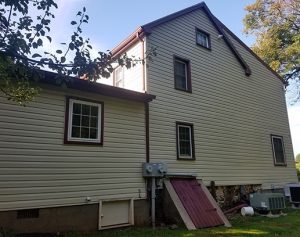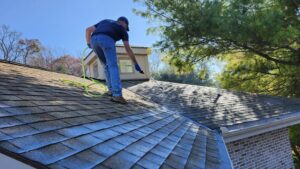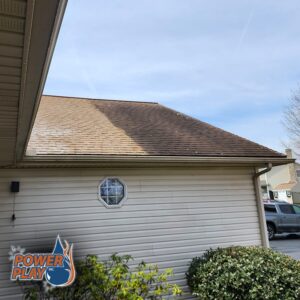
I can’t count how many times I’ve had the “fly poop” conversation. A homeowner points to tiny black specks all over the siding and asks if it’s from flies. Sometimes it is. But most of the time, if the specks look like the ones pictured below, it’s not fly poop at all. It’s artillery fungus.
I’ve owned Power Play since 2002. That’s over 24 years of washing homes, and I’m still out in the field. Between me and Rick, our top two techs, there’s more than 45 years of combined experience, and with over 400 five-star reviews across Lebanon, Lancaster, Dauphin and Berks counties, we’ve seen a lot of artillery fungus. Here’s what it is, why it’s so stubborn, what we can and can’t do about it, and how you can keep it from coming back.

What Artillery Fungus Is
Those small black spots are the spore masses of artillery fungus (Sphaerobolus stellatus). They’re usually round, about the size of a pinhead, and they’re sticky. If you scrape one with your fingernail, the top comes off, but a stain or residue is usually left behind on the surface. Some people call them “shotgun spores.” The artillery and shotgun names come from how the fungus spreads: when conditions are right, it shoots its spores into the air, and they stick to whatever they hit.
Where It Comes From
Artillery fungus lives in mulch, especially wood-based mulch that stays damp and shaded. Homeowners who don’t use mulch rarely have a problem, and when they do, it can come from a neighbor’s beds. The spores shoot toward light, so they often show up on light-colored siding near mulched beds, usually on the lower part of the wall and on shady, damp sides of the house. They’ll stick to siding, painted surfaces, windows, trim and even cars parked nearby.
Why It’s So Hard to Remove
This is the honest part. Artillery fungus spores are glued to the surface with a sticky coating that’s built to hold on. Once they’ve been there a while, they bond to the siding and usually leave a stain behind even if the spot itself comes off. According to Penn State, the spores have a 7 to 10 year life cycle, and after that they tend to come off more easily.
High pressure and hot water have shown limited success on artillery fungus, but that process is not safe for your home. It can warp vinyl, force water behind the siding, etch wood and strip paint, and it still won’t take off every spot. That’s why we don’t offer artillery fungus spot removal.
How We Handle It
Soft wash the home. We wash the home with our low pressure, high flow soft wash process. There’s a huge difference between about 500 psi and the roughly 3,500 psi of high pressure. Our cleaning solutions kill the mold, mildew and algae on the siding and clean the surface, so the whole wall looks better.
We don’t remove the spots. We’ll be upfront with you before we start: our house wash won’t take off artillery fungus spots, and we won’t risk your siding trying.
Surface safety. Vinyl, painted wood, stucco and other surfaces don’t all get the same treatment. We adjust our approach for each surface. Our products are biodegradable and plant-safe when used with our process, and we rinse thoroughly so nothing is left on your siding, landscaping or windows.
The right gear. We bring top-of-the-line equipment, ready for any situation, carried on board our trucks: a professional power washer, dedicated pumps, a window cleaning system, soft wash equipment and more. If spores have landed on your windows, our window cleaning is available on its own or added to your house wash.
Honest expectations. Even with artillery fungus spots, a safe, solution-based cleaning makes a big difference on the home overall. For more on how we wash homes, see our House Pressure Washing page.
What You Can Do Yourself
If a few spots really bother you, a melamine sponge (like a Mr. Clean Magic Eraser) is one of the few DIY methods that works at all. It’s a lot of hard work and it may dull some finishes, so test a small hidden area first and go easy.
How to Prevent Artillery Fungus
Preventing it is much easier than removing it. Here’s what we recommend:
- Cut back on wood mulch near the house, especially mulch made from rotting wood.
- Use decorative stone or rubber mulch in beds next to the siding. I use rubber mulch at my own home with great success.
- If you stick with wood mulch, larger bark nuggets and cedar or cypress tend to be less of a problem than fine hardwood mulch.
- Rake and refresh mulch beds so they don’t stay matted and damp, or add a fresh layer each year over the old one.
- Some research suggests mixing in spent mushroom compost (around 40%) can suppress the fungus.
- Talk to your mulch supplier or landscaper and let them know you don’t want mulch that harbors artillery fungus.
Penn State Extension also has good background on artillery fungus if you’d like to read more.
Ready to find out what we can do for your siding? Call Nate at 717-314-2360 for a free quote.
PA HIC #PA062176